Watershed & Conservation, BS
Study the movement of water and the care of connected habitats.
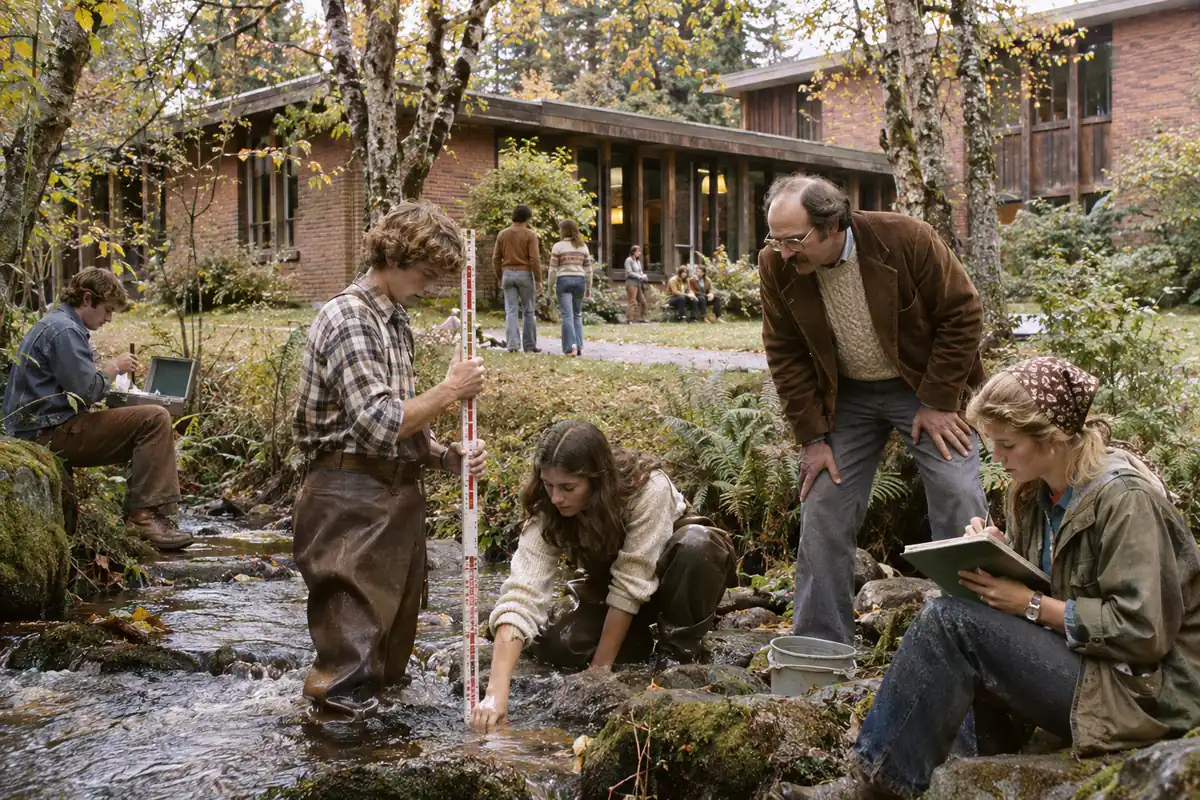
Follow water through a landscape.
A stream connects more than the places on its banks. Watershed & Conservation brings maps, ecological observation and restoration planning together so you can understand how a change in one part of a landscape may matter elsewhere.
You will practice monitoring methods before using them to compare conservation choices. Field records, project constraints and a plan for evaluating progress belong in the same conversation.
The degree in view
The BS requires 120 semester credits. The shared core connects your specialized study with writing, evidence, interpretation and public life. An adviser helps you choose electives that fit your interests without losing sight of the degree requirements.
Required courses
ENVS110Earth Systems
Trace connections among water, soil, climate and living communities using maps and introductory field observations. 3 credits. Prerequisites: none.
BIOL110Biology of Living Systems
Investigate cells, populations and ecological interactions through integrated discussion and scheduled laboratory work. 3 credits. Prerequisites: none.
STAT150Introduction to Statistics
Summarize samples, explore variation and use elementary statistical inference in a reproducible analysis. 3 credits. Prerequisites: none.
WCON150Watershed Landscapes
Read the relationship among drainage, land cover and habitat through map study and site observation. 3 credits. Prerequisites: none.
WCON220Stream Monitoring
Practice stream measurements, sampling records and comparison of seasonal observations. 3 credits. Prerequisites: WCON150.
WCON310Restoration Planning
Develop restoration options using site constraints, ecological objectives and a monitoring schedule. 3 credits. Prerequisites: WCON220.
WCON410Conservation Decisions
Compare conservation alternatives, maintenance needs and the evidence used to judge progress. 3 credits. Prerequisites: WCON310.
WCON490Watershed Capstone
Produce a restoration or monitoring proposal with a field record, budget assumptions and evaluation plan. 3 credits. Prerequisites: WCON410.
A related-study pathway
One approved related-study pathway; the sample plan uses these six courses. Alternatives require an adviser-approved sequence with the same credit value.
An eight-semester example
The plan below completes prerequisites before the next sequenced course. Breadth electives come from outside the major division; free electives can support exploration or a coherent additional interest. Consult your adviser before changing a sequence.
| Semester | Courses and elective spaces | Credits |
|---|---|---|
| Year 1 · Fall | WRIT101, COMM105, ENVS110, Breadth elective, Free elective | 15 |
| Year 1 · Spring | PHIL110, HIST120, BIOL110, Breadth elective, Free elective | 15 |
| Year 2 · Fall | WRIT201, LIT130, STAT150, WCON150, Breadth elective | 15 |
| Year 2 · Spring | ARTS105, QUAN105, WCON220, ENVS150, Breadth elective | 15 |
| Year 3 · Fall | SCIE105, CIVI120, WCON310, EPOL150, Free elective | 15 |
| Year 3 · Spring | ETHI210, GLBL150, WCON410, DATA150, Free elective | 15 |
| Year 4 · Fall | ENVS220, EPOL220, Free elective, Free elective, Free elective | 15 |
| Year 4 · Spring | WCON490, DATA220, Free elective, Free elective, Free elective | 15 |
Work toward a capstone
A watershed monitoring and restoration proposal supported by repeatable site measurements.
Your proposal sets the scope, method and expected form of the final work. Scheduled reviews give you an opportunity to respond to feedback before a public presentation or exhibition.
A person to plan with
Dr. Owen Bennett
Associate Professor, Conservation Science
Alder Hall, Room 116
Riparian restoration and ecological monitoring.
Start an advising conversationConsider your next direction
The degree can support environmental project support, conservation program coordination, graduate study in a related field. Career Studio can help you translate project work into a portfolio, a clear account of methods or the preparation for further study.
Explore Career Studio