Environmental Policy, BA
Understand how communities frame environmental problems and choose among possible responses.
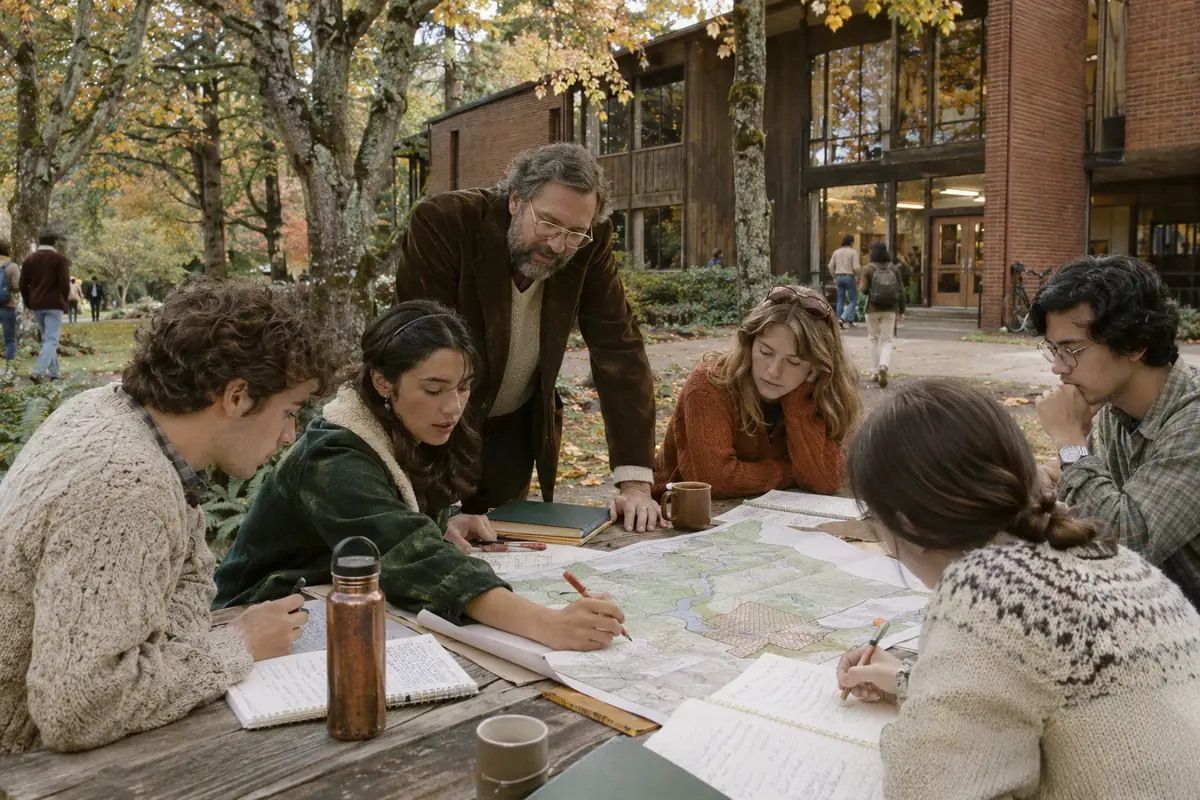
Bring evidence into a public decision.
Environmental questions reach into institutions, budgets and the lives of people who may see the same issue differently. This major asks you to compare responses using explicit criteria and a careful record of supporting evidence.
You will learn to read policy documents, frame research and design a useful participation process. The goal is a defensible recommendation that explains both its reasoning and its limits.
The degree in view
The BA requires 120 semester credits. The shared core connects your specialized study with writing, evidence, interpretation and public life. An adviser helps you choose electives that fit your interests without losing sight of the degree requirements.
Required courses
ENVS110Earth Systems
Trace connections among water, soil, climate and living communities using maps and introductory field observations. 3 credits. Prerequisites: none.
SOCI110People & Institutions
Use sociological concepts to examine relationships among individuals, institutions and social change. 3 credits. Prerequisites: none.
STAT150Introduction to Statistics
Summarize samples, explore variation and use elementary statistical inference in a reproducible analysis. 3 credits. Prerequisites: none.
EPOL150Environment & Public Decisions
Compare the scientific, social and institutional questions that shape environmental decisions. 3 credits. Prerequisites: none.
EPOL220Policy Research Methods
Build a source-based policy question and compare documents, interviews and public data. 3 credits. Prerequisites: EPOL150.
EPOL310Environmental Policy Analysis
Evaluate alternatives through explicit criteria, stakeholder perspectives and evidence of tradeoffs. 3 credits. Prerequisites: EPOL220.
EPOL410Public Participation Studio
Design an accessible public engagement process and document how responses inform a decision. 3 credits. Prerequisites: EPOL310.
EPOL490Environmental Policy Capstone
Write and defend a policy brief with options, supporting evidence and an implementation outline. 3 credits. Prerequisites: EPOL410.
A related-study pathway
One approved related-study pathway; the sample plan uses these six courses. Alternatives require an adviser-approved sequence with the same credit value.
An eight-semester example
The plan below completes prerequisites before the next sequenced course. Breadth electives come from outside the major division; free electives can support exploration or a coherent additional interest. Consult your adviser before changing a sequence.
| Semester | Courses and elective spaces | Credits |
|---|---|---|
| Year 1 · Fall | WRIT101, COMM105, ENVS110, Breadth elective, Free elective | 15 |
| Year 1 · Spring | PHIL110, HIST120, SOCI110, Breadth elective, Free elective | 15 |
| Year 2 · Fall | WRIT201, LIT130, STAT150, EPOL150, Breadth elective | 15 |
| Year 2 · Spring | ARTS105, QUAN105, EPOL220, ENVS150, Breadth elective | 15 |
| Year 3 · Fall | SCIE105, CIVI120, EPOL310, BUSI150, Free elective | 15 |
| Year 3 · Spring | ETHI210, GLBL150, EPOL410, DATA150, Free elective | 15 |
| Year 4 · Fall | ENVS220, BUSI220, Free elective, Free elective, Free elective | 15 |
| Year 4 · Spring | EPOL490, DATA220, Free elective, Free elective, Free elective | 15 |
Work toward a capstone
A policy brief comparing feasible responses to a clearly defined environmental issue.
Your proposal sets the scope, method and expected form of the final work. Scheduled reviews give you an opportunity to respond to feedback before a public presentation or exhibition.
A person to plan with
Dr. Adrian Brooks
Associate Professor, Environmental Policy
Alder Hall, Room 120
Environmental decision-making and public participation.
Start an advising conversationConsider your next direction
The degree can support environmental project support, conservation program coordination, graduate study in a related field. Career Studio can help you translate project work into a portfolio, a clear account of methods or the preparation for further study.
Explore Career Studio