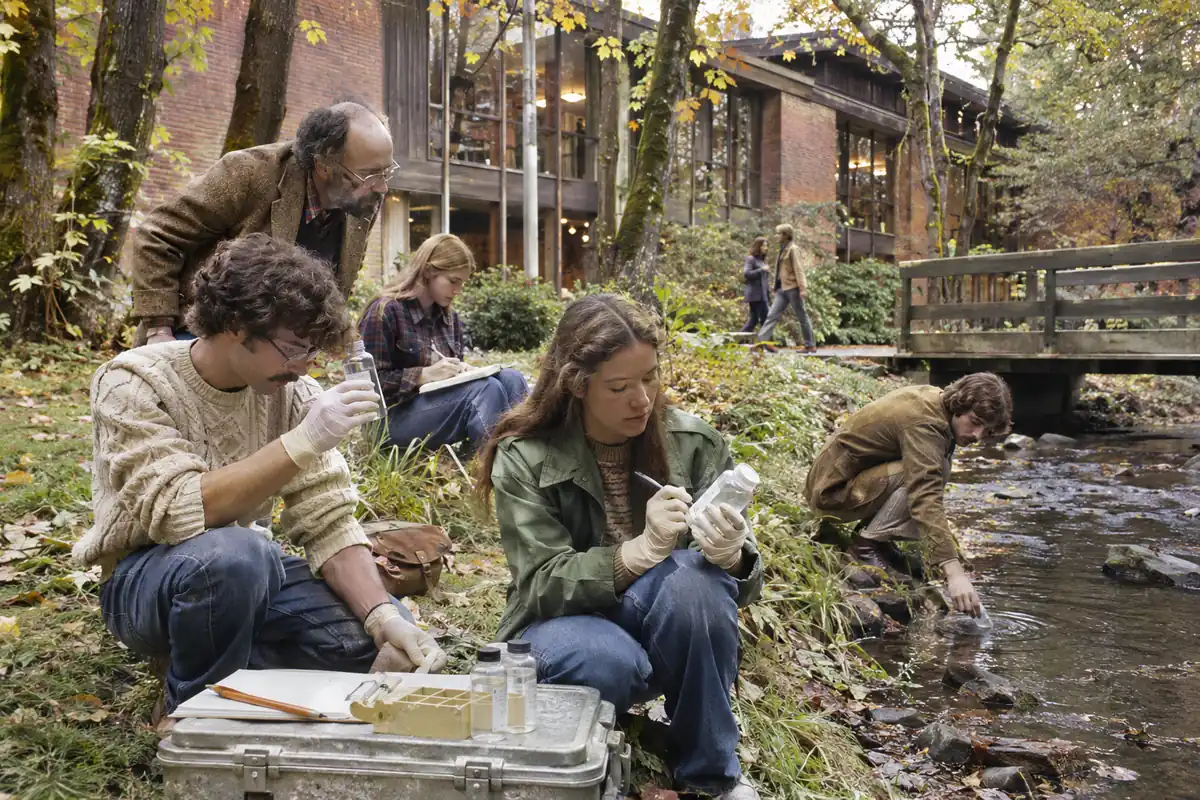
The first task is to write down what is there. Before a bottle is filled or a measurement recorded, students at Fern Creek note the weather, the recent rainfall visible in the channel and the place where they are standing.
That small routine is at the center of this autumn’s field teaching in Environment & Natural Systems. Supervised groups are returning to the same stretch of creek to build a record that can be read alongside the September baseline.
For Dr. Leah Hart, who leads the environmental science field sequence, the value lies in making the process visible. A useful record explains not only what a group found, but also how it looked, where it sampled and which conditions might affect a comparison.
A shared method, a better question.
Students work in rotating roles. One keeps the field notebook, another checks the location and sampling sequence, and another labels the materials that will return to the preparation bench. The roles change on the next visit, giving each student practice with the whole process.
The notebook includes ordinary details that can become important later: a shaded bank, a recently disturbed patch of soil, a different water level or a sample that needs to be set aside because the label is incomplete.
Back in class, the groups compare their records before comparing their results. They look for gaps in the method, discuss the limits of a small set of observations and identify a question that a later visit could help answer.
Learning what a comparison can say.
The October observations are not a verdict on the creek’s condition. A short teaching series cannot establish a long-term trend, and a change between visits may have more than one explanation. Those limits are part of the assignment.
Environmental Science students connect the field records with ecological and laboratory methods. Students in Watershed & Conservation consider the way drainage, land cover and habitat shape what can be observed at a particular point in a stream.
Inside a field notebook
- Date, site location and weather conditions.
- A clear account of the method and equipment used.
- Sample labels that match the written record.
- Observations kept separate from interpretations.
- A question to take into the next visit.
A place to return to.
Fern Creek Field Station supports scheduled classes, equipment preparation and supervised visits. Groups meet the teaching team before traveling to the station, and the route or activity can change when weather or site conditions call for it.
On November 21, the college will host a guided observation walk for a small group of visitors. The morning includes a field preparation conversation, a reading of the streambank and time to compare notes at the station.